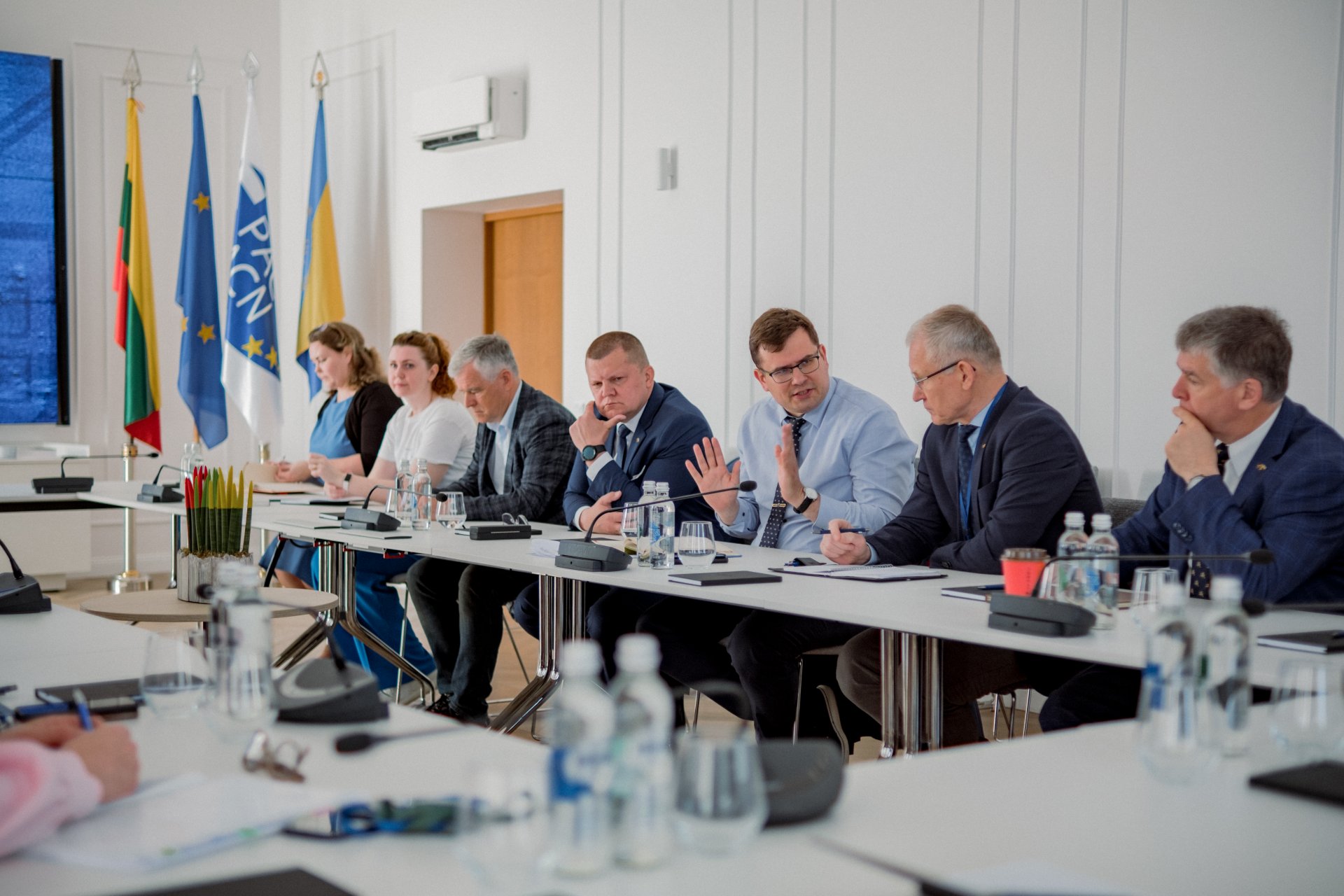
In 2021, the Special Investigation Service (STT) focused its activities on reducing the risks of corruption as a threat to national security. More and more often corruption is seen as a tool of hostile action against the State. Therefore, the systematic and active involvement of all Lithuanian authorities is extremely important. Today, this was discussed at the outgoing meeting of the Committee on National Security and Defence of the Seimas.
‘Corruption should be understood as one of the threats to national security. Even though Lithuania has already done a lot in the fight against corruption, a systemic threat, however, requires a systemic response. Besides the activities carried out by the STT, the following are also required: the attention of all constitutional authorities of Lithuania to reducing the risks of corruption; involvement of all, without exception, heads of the public sector institutions in creating a corruption-resistant environment; establishment of an anti-corruption dialogue with the society by publicizing the activities carried out in the areas of corruption control and prevention. All of this together can be called an anti-corruption ecosystem, that effectively reduces the risks of corruption, as a threat to national security’, - says Žydrūnas Bartkus, Director at the STT.
Harmonious actions of the public sector and of the civil society in the field of anti-corruption play an important role
During the presentation today to the Committee on National Security and Defence of the Seimas the evaluation of the corruption situation in Lithuania, Ž. Bartkus, Director at the STT, noted that more and more often corruption can be identified as a tool of hostile action against the State. It can be seen that this tool is used to weaken national security, which is most vulnerable in those states, which failed to put in place, on time, measures that ensure transparency, resilience and accountability of the Government.

In order to strengthen national security, it is important to identify, on time, potential risks, including the risk of corruption, and take appropriate actions to neutralize them.
Only after ensuring a unified approach of all the country's authorities to the importance of increasing transparency, it is possible to take actions, which help create an anti-corruption environment in Lithuania. Greater promotion of openness in decision-making, of initiatives and responsibilities - these are the necessary steps in increasing resilience to corruption in the State.
In 2021, the civil society was twice as active
Improvement of the civil society indicators and the increasing activity can become an example of involvement in creating an anti-corruption environment. In 2021, the STT received 4,350 reports, which is twice as much as in 2020. The growing number of reports suggests about the increasing confidence of the society in the Service. The share of anonymous reports decreased by 3.5 times - they account for 5.8% of all reports received.
In 2021, the value of the assets, that the STT sought to return to the State - more than 6 million euros
In 2021, the STT initiated 72 pre-trial investigations (in 2020 - 69) and has established 457 criminal offences of a corrupt nature, that is, 20% more than in 2020. Suspicions have been brought against 246 persons (in 2020 – against 102), of which 44% of the suspects held managerial positions. In 86% of the cases, investigated by the STT, the persons were found guilty by courts.
In 2021, the value of the assets, that the STT sought to return to the State exceeded 6 million euros: the fines imposed amounted to 392 thousand euros, 1.137 million euros were confiscated, the property rights, worth 4.5 million euros, were restricted.
In order to return to the State anything acquired illegally from criminal offenses of a corrupt nature, the conduction of the analytical anti-corruption intelligence, using the big data analysis, was initiated in the process of searching for assets. The use of new tools makes it possible to identify more effectively the persons who have acquired assets in a potentially illegal manner.
More than 1,000 corruption prevention proposals made by STT will have a positive impact
In 2021, in evaluating the investors in strategically important sectors of the economy and the parties to the transactions of the companies important to ensuring national security, the analytical anti-corruption intelligence officers of the STT performed inspections of almost 700 natural and legal persons. The information was transferred to the Commission for Coordination of Protection of Objects of Importance to Ensuring National Security.
According to the data of the corruption prevention monitoring, that was carried out in 2021, 76% of the comments submitted by STT have been implemented, are being implemented or will be implemented. More than 1,000 corruption prevention proposals made by STT will have a positive impact on the anti-corruption environment.
According to the data of the corruption prevention and analytical anti-corruption intelligence, the fields of health protection, territorial planning and construction supervision, self-government, environmental protection and public procurement are characterized by a high risk of corruption.
The Service is constantly improving various anti-corruption awareness raising measures and presents them to the society - from the electronic learning platform, that attracted a great deal of interest, the first in Lithuania anti-corruption hackathon to the Transparency Academy, which continued its activities. In 2021, about 350 lectures, practical seminars and anti-corruption events were organised. They were attended by almost 17,800 persons - twice as much as in 2020.
The 2021 Activity Report of the STT can be found here.
The Special Investigation Service (STT) is the main anti-corruption law enforcement authority of the Republic of Lithuania, which is accountable to the President of the Republic of Lithuania and the Seimas of the Republic of Lithuania.