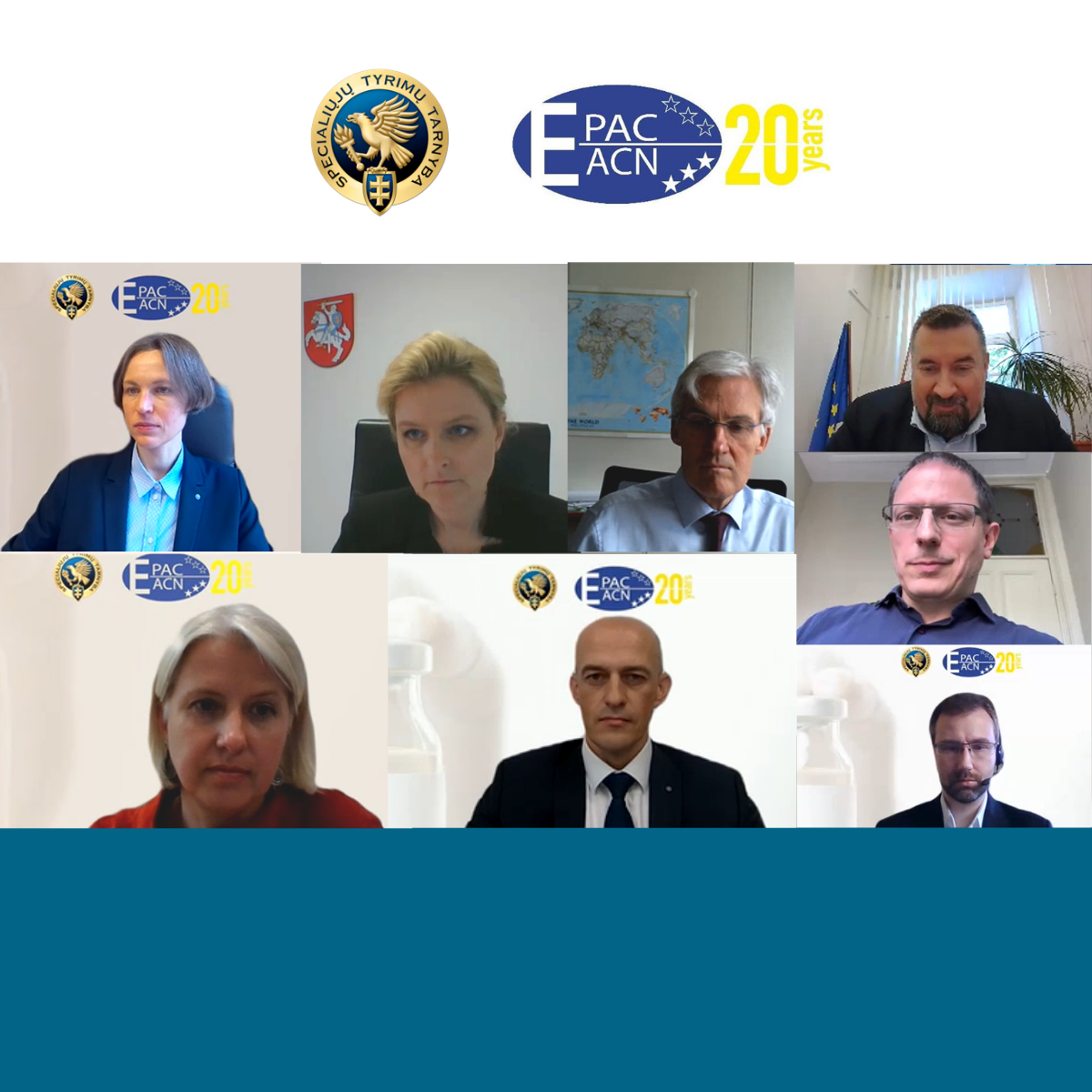
On 14 May 2021, Special Investigation Service of the Republic of Lithuania (STT) and EPAC/EACN, which is a network of European anti-corruption and police oversight bodies, organized jointly the webinar "COVID-19 vaccination and managing corruption risks". More than 70 experts from law enforcement, corruption prevention and healthcare sectors from various European countries (Spain, Portugal, Romania, Poland, Moldova, Finland, Czech, Cyprus, Bosnia and Hercegovina, Austria and etc.) attended the online event.
The webinar was dedicated to discuss potential corruption risks in vaccination process, as well as other measures in response to COVID-19, and the tools to address these risks.
Representatives of the United Nations Office on Drugs and Crime (UNODC), EUROPOL’s European Financial and Economic Crime Centre (EFECC), the Polish Central Anti-Corruption Bureau, the Ministry of Health of the Republic of Lithuania and the Lithuanian Special Investigation Service (STT) presented their analysis and insights from the national, regional and international perspectives at the webinar.
STT Director Mr. Žydrūnas Bartkus stressed that lack of trust in public integrity and in ability of public authorities to combat pandemic are like vitamins for corruption to grow. In a state-emergency situation, it is more than ever important to talk about transparency and integrity in providing healthcare and other essential services to citizens in order to bring back the trust in public governance.
The conditions are optimal for corruption exposure, agreed with him Mr. Frédéric Pierson, representative of the EFECC, also sharing data about dramatic differences of purchase prices of protective equipment in public procurement processes within in many European countries.
„It is important to ensure that the vaccination process is transparent. Corruption risk management measures must be adequate to the objective pursued and not create unnecessary administrative burdens”, underlined Ms. Jurgita Grebenkovienė, Chancellor of the Lithuanian Ministry of Health.
Mr. Tim Steele, expert of the Corruption and Economic Crime Branch at the UNODC, mentioned that in order to oversee the vaccine administration process, anti-corruption authorities and citizens are in need to access to some personal data of those vaccinated. “Countries must weigh between data protection and the social interest to have access to enough information to oversee the process", stressed the UNODC representative.
“Use of analytical tools is an effective measure to increase transparency and improve corruption risk management in COVID-19 vaccination process”, agreed with him Ms. Laura Ūselė, head of one of analysis divisions at the STT.
“Conflicts of interest is another underestimated threat on the pharmaceutical market”, said healthcare expert from Polish Central Anti-Corruption Bureau.
The European Partners against Corruption (EPAC) and European contact-point network against corruption (EACN) are independent forums for practitioners, united in the common goal of preventing and combating corruption.
EPAC is composed of anti-corruption authorities and police oversight bodies from Council of Europe Member Countries. EACN, a more formal network established by a European Council decision, brings together anti-corruption authorities from European Union Member States. The two networks mostly work together as one, given their equal mission and goals.
Lithuanian STT, like most anti-corruption authorities, is a member of both networks and its representative Ms. Rūta Kaziliūnaitė is currently Deputy Vice-President of the EPAC/EACN.
For more information on EPAC/EACN please see here: https://www.epac-eacn.org/.